
Music, art and movement in learning

By Tori Weiss
Have you ever wondered why your child comes home knowing a variety of songs or actions about different spelling sounds or rules? You may have attended Shine over your time here at Encounter and noticed children using their bodies to help them recite the Lord’s Prayer.
So why do Junior School teachers combine music, art and movement to learning experiences in the classroom?
A great question! I am glad you asked!
As well as making learning fun, there is a deeper, more intentional reason for engaging more than one sense in learning.
Research tells us that when students engage multiple senses to learn—e.g. drawing or acting out a concept—they’re more likely to remember and develop a deeper understanding of the material or content. True story!
“When students learn through multiple senses, their brains create stronger, more integrated memories.” Brian Mathias, neuroscientist at the University of Aberdeen.
To further evidence this, Mathias and his colleagues discovered that 8-year-old students learning a new language, had 73% better recall if they used their hands and bodies to mimic the words—for example, pretending to be a plane while learning the Japanese word “Hikōki”. Mathis concludes:
“As a rule of thumb, the more modalities implicated, the better memory will be,”
Another example is learning the concept of fractions. Understanding fractions can be tricky for many kids (and let’s be honest, even some adults!), however, a recent study showed that a fun twist on playing the much-loved Fleurieu pursuit of basketball, helped make fractions easier to grasp. (https://psycnet.apa.org/doiLanding?doi=10.1037%2Fedu0000714)
In Mathias’ study, researchers worked with over 200 students in Grades 4-6. They modified a basketball court by adding fraction labels (like 1/4, 2/4, 3/4 and 4/4) with big pieces of paper on one side and their matching decimal values (like 0.25, 0.50, 0.75, and 1.00) on the other.
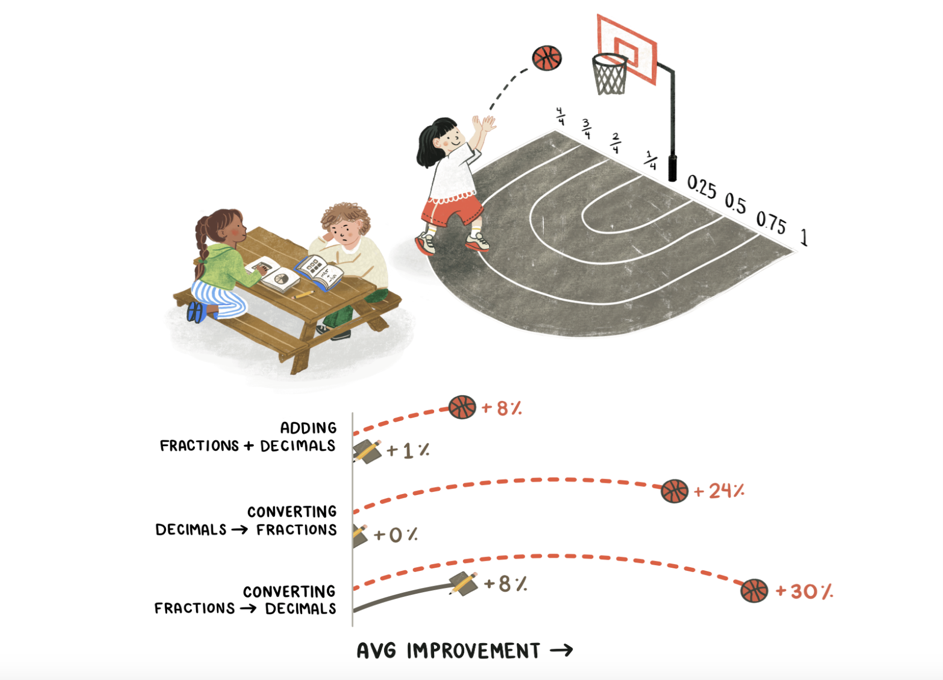
When a player made a basket, another student would call out the point value while a scorekeeper marked it on a number line.
Students also faced fun challenges, like making quick shots to reach 1.5 points. This hands-on, active approach helped students see the connection between fractions and decimals—like how 3/4 is the same as 0.75—in a clear and engaging way.
So, in this study, the physically active students saw improvements around 30% in their ability to work with fractions and decimals compared to their peers who just made computations using pencil and paper!
Mrs Koop (our Music and Performing Arts teacher) would also tell you, every time you combine curriculum material and/or concepts to music or movement, retention increases.
This is why you will not see children at Encounter, seated in rows, compliantly filling in worksheet after worksheet and obediently gluing them into their books. You will see our children both in the classroom and beyond it, moving, dancing, writing, miming, acting, discussing, playing and… engaging.
Isn’t that, indeed, something to celebrate?

Encounter Lutheran College acknowledges the Ramindjeri people of the Ngarrindjeri Country as the Traditional Custodians of the land on which we live, work and learn. We pay our respects to Elders past, present and emerging.
Contact Encounter Lutheran College